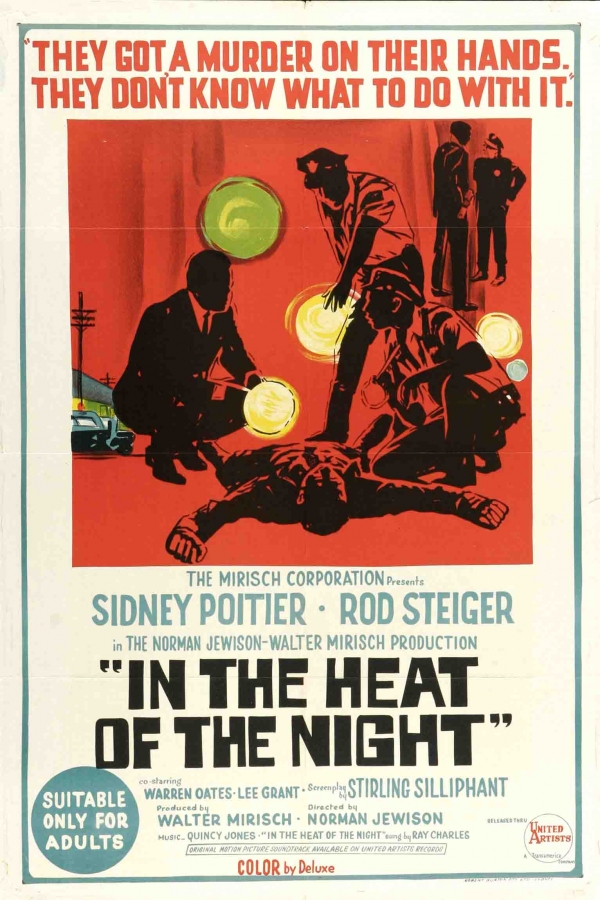
Reflections: An incredibly relevant film in 1967 and today, In The Heat Of The Night features Sidney Poitier and Rod Steiger in the heart of Sparta, Mississippi as they attempt to solve a homicide in the midst of tense racial conflict. I was highly impressed with Poitier and Steiger as the accoladed story brings out the heat in their internal battle between pride and justice. Hitting screens at the close of the American Civil Rights Movement, Jewison's film delivers a powerful message of common values overreaching racial barriers, as well as the futility of intolerance. Well done, boys.
Reflections: They say "All The President's Men" is the film that launched a thousand J-School students, and deservingly so. Robert Redford and Dustin Hoffman quickly form a dynamic journalistic duo as they try to uncover the true story of the Watergate scandal. The writing in this film is just wonderful, winning the Academy Award for Best Writing, and the unique cinematography and art direction make "All The President's Men" a real treat for any cinema enthusiast.
Reflections: Hello Charlie Chaplin! Before this flick, I never realized what an advocate Chaplin was for social change. Modern Times paints a haunting picture of American industrial capitalistic culture by telling the story of a factory worker (Charlie Chaplin) as he works himself crazy in the great human machine. After facing jail time and giving audiences from good laughs, the factory worker (known as The Tramp) meets a lovely young homeless woman. Together they embrace the idea of a simple life and walk off into the sunset. Absolutely awesome.
Reflections: The Wild Bunch tells the tale of a band of wild western outlaws swept over by change. As technology and the times advance, Williams Holden and his gang of vandals want to pull one final job before they fade into the sunset. What begins as a well planned heist turns into a series of gory shootouts as the outlaws come to realize the old ways are dead. Audiences grow to pity with the bad guys in this tale as they represent the human condition through their resilience and inability to cope with change.
Reflections: Have I mentioned 1960 was a GREAT year for American film? The Apartment is a romantic dramedy starring Jack Lemon and Shirley MacLaine in a story that is nothing short of fanciful. C.C. Baxter (Lemon) is an up-and-coming businessman, mostly because he lends his apartment out to office superiors who want a discrete spot to host their love affairs. Baxter begins as a spineless little man, but through a series of mishaps undergoes a transformation into a strong character who stands up for himself. Audiences loved this black and white flick then, and I still do now. After all, there's a reason Spartacus didn't win Best Picture that year.
Reflections: Let's start this one off by saying 1960 was a good year for American film. Kubrick's Spartacus took home four Oscars, but easily could have wracked up more in just about any other year. Kirk Douglas, a true man's man, gives an outstanding performance as Spartacus, a headstrong slave who ascends to lead a revolt on the Roman Empire. Quite a different approach to the time from epic "Ben-Hur", Spartacus is an inspiring story about a man's true character in the face of dire odds. Hats off to you, Kubrick. We'll be seeing you again soon.
Reflections: In comes Sunrise at #82 as the first silent film on the countdown. Murnau's work was definitely interesting, and it was deemed quite creative at the time, claiming the Academy Award for Best Picture, Unique and Artistic Production. The story follows a farmer who becomes enchanted by a big-city woman and is driven to the point of attempting to murder his wife. Perhaps the film's message is best summed up in an opening title card:
"For wherever the sun rises and sets, in the city's turmoil or under the open sky on the farm, life is much the same,; sometimes bitter, sometimes sweet."
Reflections: It was only a matter of time til James Cameron made his presence known on the countdown. In the late 90's, Titanic was pure epic. Three hours of star-crossed lovers fighting the odds on the world's most impressive vessel? What's not to like? The Academy seemed to think so as well, as Titanic took home a whopping 11 Oscars that year. I particularly thought the score was impressive, with Celine Dion putting the icing on the cake.
Reflections: Written, acted, and directed by Dennis Hopper and Henry Fonda, Easy Rider is essentially a social commentary on 1960's counter culture. Truthfully, I didn't fall in love with this one right away. Although, I was certainly alert during the 10 minute first-person New Orleans acid trip sequence. I fully believe that's what an acid trip in The Big Easy would look like. Drugs aside, the story does have a powerful message that shines light on intolerance to anything that challenges societal norms.
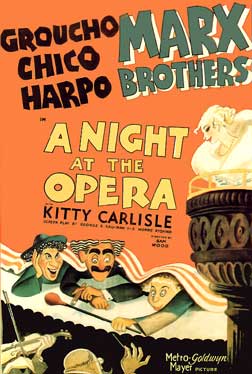
Reflections: A Night at the Opera showcases The Marx Brothers in a picture loaded with witty 1930's Marx Comedy. Groucho, Chico, and Harpo take the screen as a group of renegades dead-set on uniting two star-crossed opera lovers, specifically by helping a young tenor find his way onto the main stage. Shenanigans ensue as the band defies authority and takes great pleasure in sticking it to the man. It's a bit drawn out at times, but if you've never seen Groucho Marx in action, this a great starting point.
Reflections: The tagline of this film is "The first casualty of war is innocence." Duly noted. With brilliant performances from Sheen and Dafoe, Platoon takes viewers into the heart of Vietnam. Sheen plays a young solider who enlists with high ideals, but during his first deployment, his innocence is shattered as he comes face to face with the cold truths of war. His journey translates into what is arguably the most powerful war movie in American history.
Reflections: 12 Angry Men is a fantastic social commentary in the heart of late 1950's New York as a room full of jurors deliberate the fate of a hispanic boy being charged with the murder of his father. Henry Fonda delivers a moving performance as the strong spoken idealist amidst a room full of prejudice and distracted minds. I enjoyed the focus Sidney Lumet's film places on the importance of life, along with the current racial inequality in the judicial system.
Reflections: What's better than a film starring two of the nation's funniest, and most charismatic, onscreen personalities? A film starring two of the nation's funniest, and most charismatic, onscreen personalities AND a leopard named Baby. Cary Grant is the man, Katherine Hepburn is laugh-out-loud funny, and Bringing Up Baby is worth its weight in pure screwball comedy gold. This flick was one of my favorites in elementary school when I watched it with my mom, and it remains near and dear to my heart today.
Reflections: Take a quick trip back to 1999 and remember the first you saw this film and M. Night railed you with the twist? "Really!? Bruce Willis was dead the whole time!? #WorldRocked" - @mrjakemorgan if Twitter had existed pre-Y2K.
You got us, Shymalan, not every gift is a blessing!
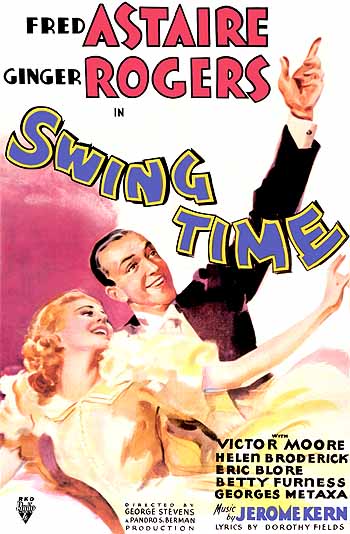
Reflections: Swing Time, which features Fred Astaire at his best, is a masterpiece filled with lively music and phenomenal dance numbers. However, as I watched this film, only one thought seemed important in my mind: I need to learn to dance, build a time machine, travel to 1930, and marry Ginger Rogers. She was a doll if there's every been one, and Rogers provided the perfect balance for the suave Astaire.
Reflections: Sophie's Choice made me realize why Meryl Streep
is considered one of the greatest actresses of all time. In her Academy Award
winning performance as Sophie, a post-WW2 Polish immigrant with a troubled
past, Streep will genuinely touch your heart. When a young southern writer
named Stingo (Peter MacNicol) moves to Brooklyn and befriends Sophie, along
with her volatile lover, Nathan (Kevin Klein), he becomes overwhelmed by how
deep the rabbit hole goes. Powerful story. Chilling conclusion.
For those of you who have been following my pursuit of viewing America's most influential films, thank you and fear not! I have indeed continued my quest to watch the AFI Top 100, and with much success, but I have failed to post my thoughts via blog. For that, I apologize.
Honestly, I had trouble finding the time and motivation to continue writing when life got busy. I realize this can easily happen to the best of us, but I'm going to attempt to not let that be an excuse. From this moment on, I will resume posting my reflections. This time, however, I'm going to take the socially savvy approach and attempt to summarize my thoughts into 500 characters of less. This will make The Year of 100 Films (1) easier to read and (2) less time consuming to write. Thank you for bearing with me.
Scorsese brilliantly tells a captivating tale covering 30 years of life in the mafia. Based on a true story, Goodfellas follows gangster Henry Hill (Ray Liotta) as he sparks into a life of organized crime, accompanied by fellow crime men Jimmy Conway (Robert De Niro) and Tommy DeVito (Joe Pesci). From the time he was 15, Hill always wanted to be a gangster, and three decades later, he reaps the fruits of his labor.
It took me a while to get around to this one, but I'm really glad I finally found a few hours to squeeze it in. I thought the acting was top notch, especially Lorraine Bracco's portrayal of Henry's wife, Karen. Her character shows us a rare side of the crime film: the weary wife of a mobster. As for the story, its telling feels highly realistic, which is sometimes hard to find in films based on true events. It was also interesting to see the art direction adapt as the film progressed from the 50's to the 80's.
Weighed against one another, I believe I enjoyed Scorsese's The Departed more, but, in closing, I'm glad Goodfellas has a new home on my film shelf.
Best Writing, Screenplay Based on Material from Another Medium
In The French Connection, Gene Hackman plays a rough, tough, don't-take-crap-from-no-one detective named Jimmy "Popeye" Doyle. When Popeye and his partner, Det. Buddy Russo, stumble upon a French drug smuggling circuit, the streets of New York are transformed into a crime scene.
Most well known for its revolutionary train vs. car chase scene, The French Connection brings a surplus of action to the table. When Hackman's character isn't drinking or picking up girls (who he may or may not meet on a bicycle), he's driving around the streets of NYC busting crime. Overall, Popeye Doyle is a very likable character. You can't help but cling to him right off the bat when he beats down a drug dealer while wearing a Salvation Army santa suit. His stalwart stature and raw determination make him an ideal hero for the narcotic streets of New York. Popeye's just the kind of cop who always gets his man. Well, almost always.
Anyway, speaking of the train vs. car chase scene that "stands the test of time", I can only imagine how many minds it blew in 1971. With it's lightning fast cuts (note the Academy Award for editing) and sky high tension, I would be willing to wager this scene turned more heads than any chase sequence since Ben-Hur's Chariot race back in 1959. At first glance, this scene reminded me of both Batman Begins and The Dark Night, along with any other film with notable car chase scenes (Bourne Identity, Gone in 60 Seconds, The Fast and the Furious, etc) Yes, it's influential.
All and all, I really enjoyed this film. Gene Hackman was great, the action was entertaining, and the writing was worthy of its Academy Awards. However, I did feel a bit short changed with the ending. The abrupt closing of the film just kind of gave me and my friends a "blah" feeling. I won't spoil the final few minutes of the movie, but after 100 minutes of great film, the last four leave you asking, "Seriously?"
Academy Awards: Best Writing, Screenplay Written Directly for the Screen
In this twisting tale, Pulp Fiction follows the lives of a boxer, two hit men, small time outlaws, along with a mob boss and his wife in a witty adventure packed with crime, retribution, and a touch of grace.
First, Quentin Tarantino can write a screenplay. Can't argue with that. In this story, he pursues at least five protagonists as they're pitted against their environment, their lifestyles, and eventually one another. The tale is also told out of sequence, so on our first time through we get to play the guessing game of when and where the action takes place. Not only does the intricately winding, protagonist-packed story stay interesting for the whole two and half hours, but the dialogue is just indisputably witty and original.
If I had to choose a favorite set of dialogue, which is truthfully very hard to do, I would have to go with the first interaction between mob men Vincent Vega (John Travolta) and Jules Winnfield (Samuel L. Jackson). With Kool and the Gang's "Jungle Boogie"setting the ambiance, the two cruise up to retrieve a mysterious briefcase from a group of amateur thieves. In a span of ten minutes or so, Jules and Vince cover everything from how to order fast food in France to Netherlandish hash to the sexual implications of a foot massage. In a perfectly balanced line between comedy and drama, the two reveal many character traits, give the audience some crucial backstory to the their mob boss (Ving Rhames), and even find time to formulate a game plan to retrieve the target. This lovely dialogue transitions into to the next scene where we have the pleasure of enjoying what is surely one of Samuel L. Jackson's greatest acting performances. From there, Pulp Fiction hits the high gear and never take's it's clever foot off of the pedal.
By the time we've met Mia Wallace, Butch Coolidge, as well as Pumpkin & Honey Bunny, the story comes full circle. At this point, there's nothing left to do but get out of your seat, change your pants, and wonder what exactly was in the briefcase... I could pretty much go on for days about the screenwriting, but I need to knock a few more items off of my to-do list before dinner.
Please, allow me to close on this note. For anyone looking for clever screenwriting and an intriguingly elaborate story, I highly recommend Quentin Tarantino's Pulp Fiction.



.jpg)